An experience app on Tesla’s Fleet API
Built around a household’s mornings, not the car’s menus.
You tell it when you leave. It reads the forecast and the garage, decides whether the battery needs warming, sets it on the car, and checks that it landed.

The kitchen is a generated photo. The screen in it is the real page, with sample data.
What we mean by an experience app
None of this is a new feature of the car. It is what the car can already do, arranged around how people actually live. The API is the raw material; the household’s routine is the design brief.
Tesla’s Fleet API makes that possible: documented endpoints, signed commands and a real developer program. That is rare among car makers, and it means a small studio can build something a household uses every day.
Three checks before every departure
A cold battery gives less range and recovers less energy when you brake. Warming it on wall power before you leave fixes both, but only if someone remembers to ask for it, at the right time, on the right mornings.
- The night before
Reads the forecast
Hour by hour, for the stretch before you leave. A warm night means no warm-up and no reason to bother the car.
- Three hours before
Checks again
Forecasts move. The plan moves with them, and so does the time if you nudged it.
- Close to departure
Asks the car
How cold is the garage, really? The car’s own reading beats any forecast.
- Then
Sets it, and reads it back
The warm-up goes on the car, and the app reads it back to be sure it landed. If it did not, the driver’s phone says so, and says what to do.
The phone does as little as possible
The setup is when you leave. After that, one tap skips a morning or nudges the time, a trip that is not on the schedule takes a few taps, and a place shared from your maps app shows up on the car’s screen.
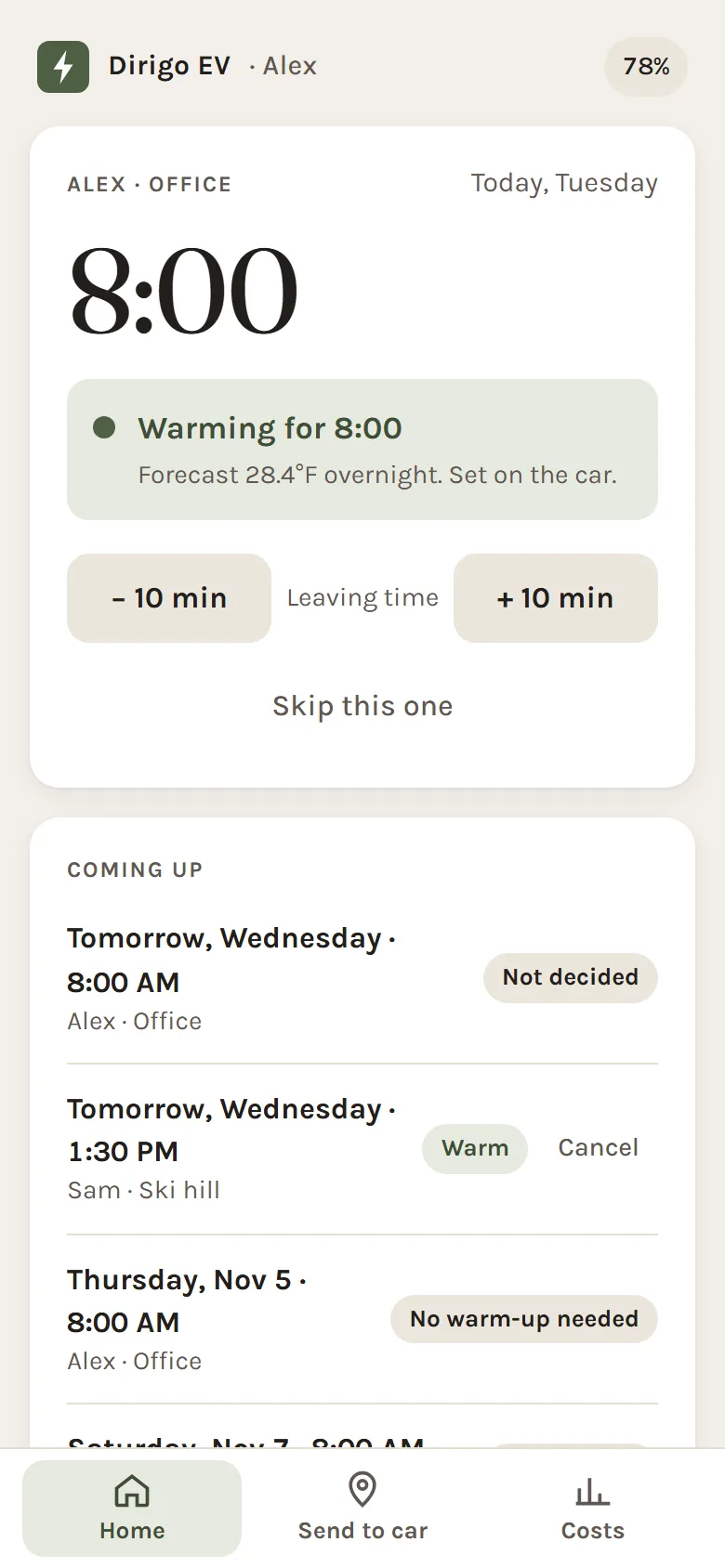
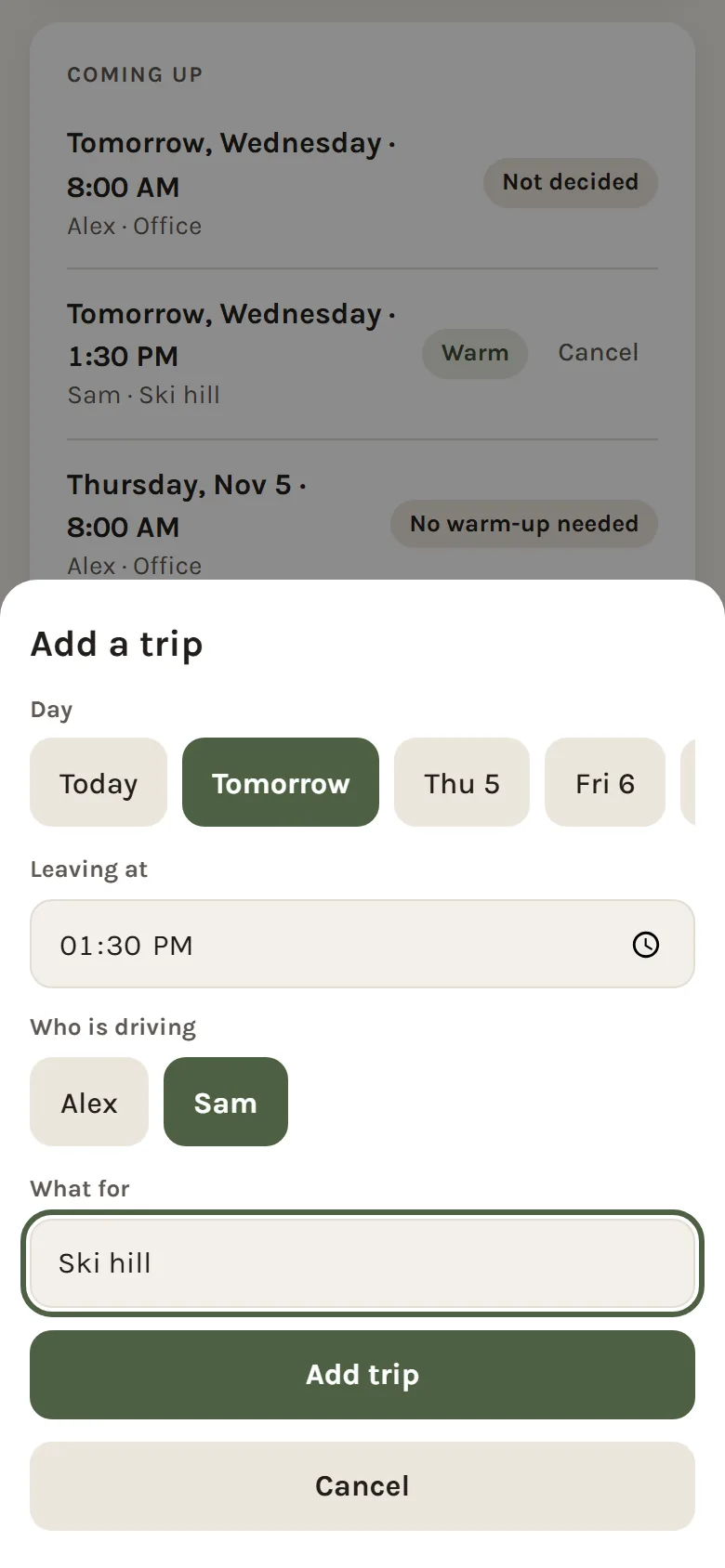
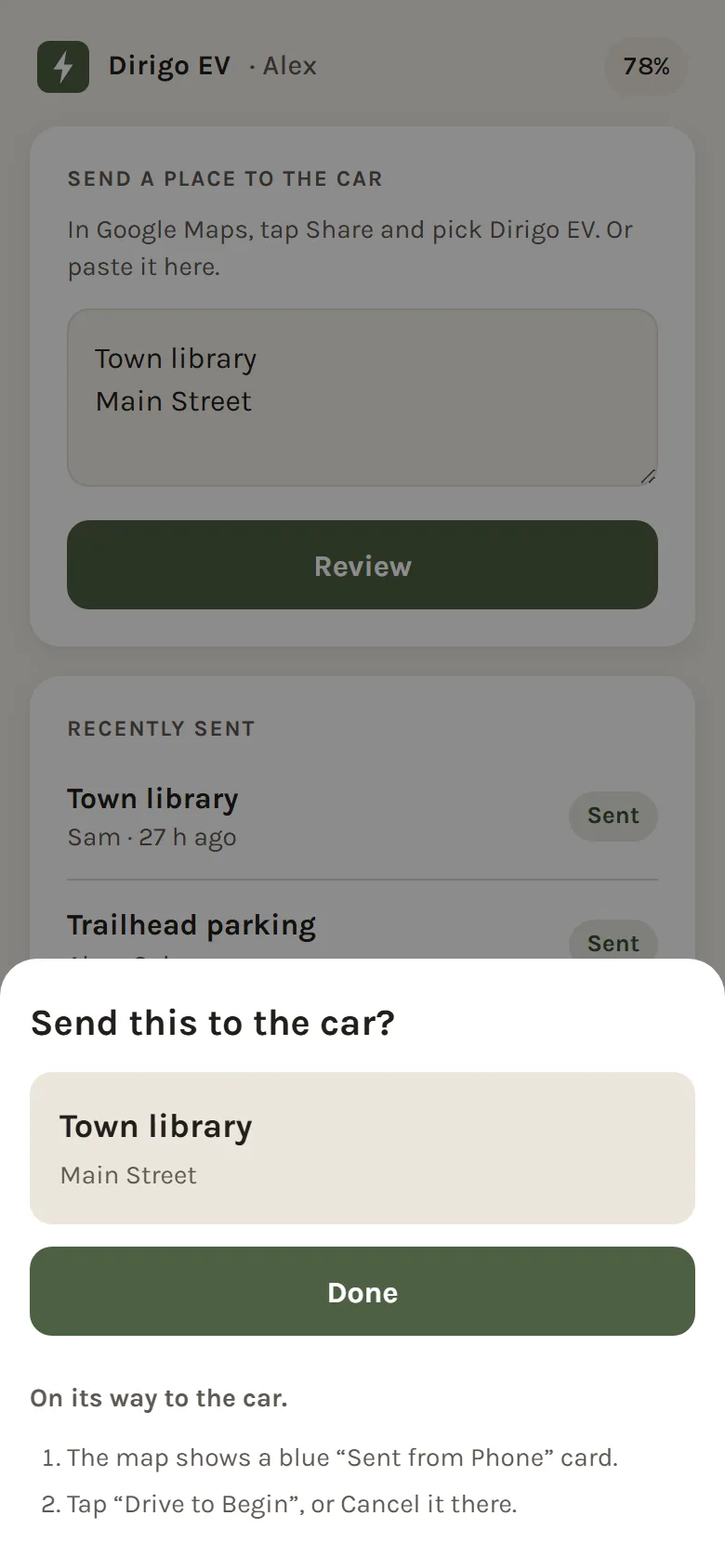
Screens from the app, with sample names and places.
A screen by the door
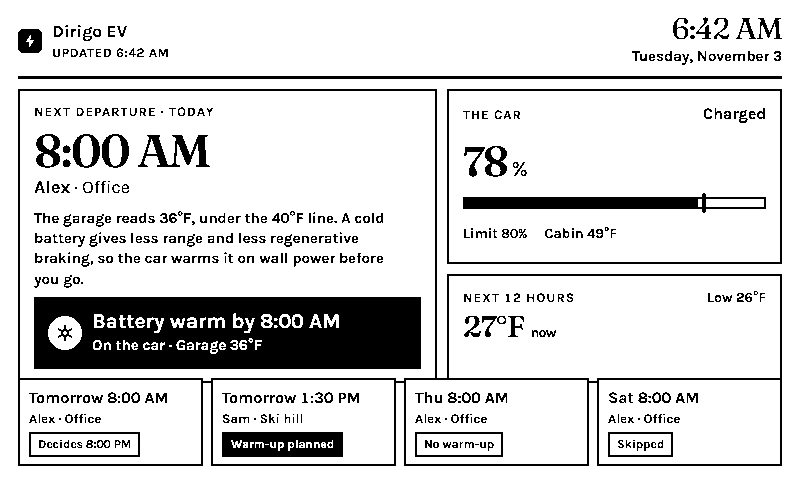
The same plan, read-only, for whoever is grabbing their keys: the next departure, whether the battery will be warm, the car’s charge and the morning’s temperatures. On a tablet it follows the room from day to night.
Or it can be quiet. The calm view looks like paper and turns slowly between three scenes: the car, the next departure and the week ahead.
On a real e-paper panel it is black on white, redraws every few minutes and runs on almost no power.

Polite to the car
Every request to a car is metered, and a car woken for nothing drains its own battery. So the app is built to stay out of the way.
Never wakes the car just to look
It wakes the car only when a decision depends on what the car says. The screens work from what it last saw.
Watches its own pace
It counts every call it makes. If anything starts to loop, it stops itself at a small daily ceiling and says so, rather than run up a bill.
The car stays the source of truth
Nothing is "done" until the app has read it back from the car. The car’s own schedules are left alone.
What comes next
The plan for the project, in the order it is being built.
- Trips that know the terrainGive a trip a destination and it reads the route’s climbs and descents, estimates the energy as a range, raises the charge the night before only when the trip needs it, and sends the destination to the car.
- The family calendarDepartures come from the calendar the household already keeps, so a dentist appointment becomes a warm car without anyone typing it twice.
- Charging that finishes at departureThe battery reaches its target right when you leave, warm, rather than sitting full and cold overnight.
- What a charge costsEach home charge, priced at the household’s own electricity rate.
An open Studio project
Build it with us.
If you build on vehicle APIs, have an idea for what a car should do for a household, or want to collaborate on what comes next, we would like to hear from you.